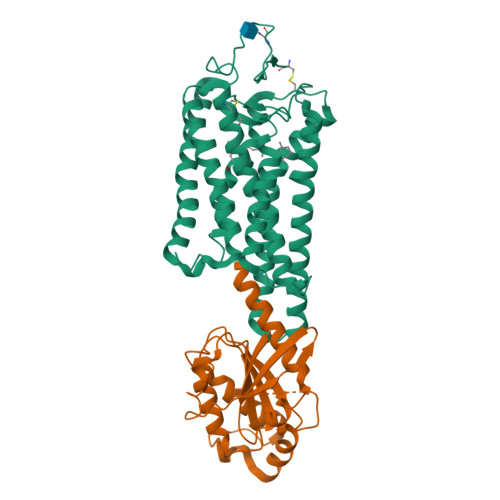
Guanine nucleotide-binding protein G(o) subunit alpha
Homo sapiensTaxon: 9606
354
氨基酸
40.1 kDa
理论值
50
PDB 条目
2
已记录
功能描述
相关疾病
Developmental and epileptic encephalopathy 17
A severe neurologic disorder characterized by onset of intractable seizures in the first weeks or months of life and usually associated with EEG abnormalities. Affected infants have very poor psychomotor development and may have brain abnormalities, such as cerebral atrophy or thin corpus callosum. Some patients may show involuntary movements.
Neurodevelopmental disorder with involuntary movements
A neurodevelopmental disorder manifesting with a wide range of clinical symptoms. Clinical features range from severe motor and cognitive impairment with marked choreoathetosis, self-injurious behavior and epileptic encephalopathy, to a milder phenotype featuring moderate developmental delay associated with complex stereotypies, mainly facial dyskinesia, and mild epilepsy. Hyperkinetic movements are often exacerbated by specific triggers, such as illness, emotion and high ambient temperature. Some patients have brain abnormalities, such as cerebral atrophy or thin corpus callosum.
氨基酸序列
MGCTLSAEERAALERSKAIEKNLKEDGISAAKDVKLLLLGAGESGKSTIVKQMKIIHEDG
FSGEDVKQYKPVVYSNTIQSLAAIVRAMDTLGIEYGDKERKADAKMVCDVVSRMEDTEPF
SAELLSAMMRLWGDSGIQECFNRSREYQLNDSAKYYLDSLDRIGAADYQPTEQDILRTRV
KTTGIVETHFTFKNLHFRLFDVGGQRSERKKWIHCFEDVTAIIFCVALSGYDQVLHEDET
FASTA 格式 · 354 个氨基酸 · 分子量 40.1 kDa
实验结构
50 PDB 条目翻译后修饰
- •Histaminylated at Gln-205 residues by TGM2
- •Palmitoylated at Cys-351, leading to binding to ADGRG3