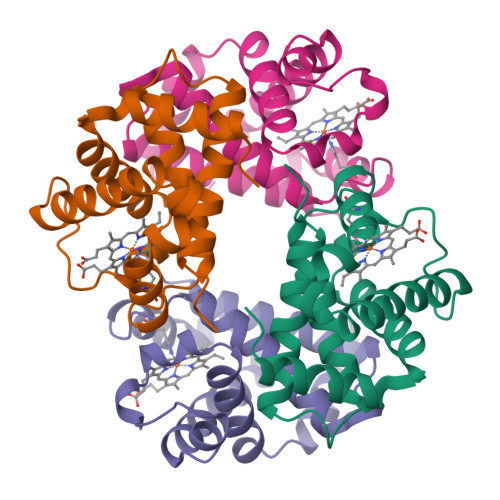
Hemoglobin subunit alpha
Homo sapiensTaxon: 9606
142
氨基酸
15.3 kDa
理论值
50
PDB 条目
3
已记录
功能描述
定位与分布
组织特异性
Red blood cells
相关疾病
Heinz body anemias
Form of non-spherocytic hemolytic anemia of Dacie type 1. After splenectomy, which has little benefit, basophilic inclusions called Heinz bodies are demonstrable in the erythrocytes. Before splenectomy, diffuse or punctate basophilia may be evident. Most of these cases are probably instances of hemoglobinopathy. The hemoglobin demonstrates heat lability. Heinz bodies are observed also with the Ivemark syndrome (asplenia with cardiovascular anomalies) and with glutathione peroxidase deficiency.
Alpha-thalassemia
A form of thalassemia. Thalassemias are common monogenic diseases occurring mostly in Mediterranean and Southeast Asian populations. The hallmark of alpha-thalassemia is an imbalance in globin-chain production in the adult HbA molecule. The level of alpha chain production can range from none to very nearly normal levels. Deletion of both copies of each of the two alpha-globin genes causes alpha(0)-thalassemia, also known as homozygous alpha thalassemia. Due to the complete absence of alpha chains, the predominant fetal hemoglobin is a tetramer of gamma-chains (Bart hemoglobin) that has essentially no oxygen carrying capacity. This causes oxygen starvation in the fetal tissues leading to prenatal lethality or early neonatal death. The loss of two alpha genes results in mild alpha-thalassemia, also known as heterozygous alpha-thalassemia. Affected individuals have small red cells and a mild anemia (microcytosis). If three of the four alpha-globin genes are functional, individuals are completely asymptomatic. Some rare forms of alpha-thalassemia are due to point mutations (non-deletional alpha-thalassemia).
Hemoglobin H disease
A form of alpha-thalassemia due to the loss of three alpha genes. This results in high levels of a tetramer of four beta chains (hemoglobin H), causing a severe and life-threatening anemia. Untreated, most patients die in childhood or early adolescence.
氨基酸序列
MVLSPADKTNVKAAWGKVGAHAGEYGAEALERMFLSFPTTKTYFPHFDLSHGSAQVKGHG
KKVADALTNAVAHVDDMPNALSALSDLHAHKLRVDPVNFKLLSHCLLVTLAAHLPAEFTP
AVHASLDKFLASVSTVLTSKYR
FASTA 格式 · 142 个氨基酸 · 分子量 15.3 kDa
实验结构
50 PDB 条目翻译后修饰
- •The initiator Met is not cleaved in variant Thionville and is acetylated
科普介绍
血红蛋白 — 血液的氧气快递员
它是什么?
血红蛋白(Hemoglobin)是你血液里最重要的蛋白质之一。它存在于红细胞中,就像一个个微型快递车,负责把氧气从肺部运送到全身各个角落,同时把二氧化碳带回肺部呼出。
为什么重要?
想象一下,如果血红蛋白停止工作,你的身体会在几分钟内因缺氧而崩溃。它每天运送数百万亿个氧气分子,是维持生命的核心分子机器。
有趣的事实
- 一个血红蛋白分子可以携带 4 个氧气分子
- 如果把人体所有血管连起来,可以绕地球两圈半
- 血红蛋白的浓度决定了血液的红色深浅
- 高铁血红蛋白症是一种遗传病,患者的血红蛋白无法正常释放氧气
结构与功能
血红蛋白由 4 个亚基组成(2个α链 + 2个β链),每个亚基都含有一个血红素辅基。血红素中心的铁离子(Fe²⁺)就是氧气结合的地方。
当氧气浓度高时(肺部),血红蛋白"张开怀抱"结合氧气;当氧气浓度低时(组织),血红蛋白"松开手"释放氧气。这种智能的结合-释放机制叫做协同效应。
疾病关联
- 镰状细胞贫血:血红蛋白基因突变导致红细胞变形
- 地中海贫血:血红蛋白链合成不足
- 一氧化碳中毒:CO 抢占氧气的结合位点
更多探索
想知道血红蛋白长什么样?点击上方的 3D 结构标签,你可以旋转、缩放这个神奇的分子!
专业数据
Hemoglobin (1HHO) — Technical Data
Structural Information
| Property | Value | |----------|-------| | PDB ID | 1HHO | | Resolution | 1.80 Å | | Method | X-ray diffraction | | Space Group | P2₁ | | Chains | A (α-subunit), B (β-subunit) | | Residues | 141 (α), 146 (β) | | Ligands | HEM (heme), OXY (dioxygen) |
Sequence Data
Alpha Subunit (UniProt: P69905)
MVLSPADKTNVKAAWGKVGAHAGEYGAEALERMFLSFPTTKTYFPHFDLSHGSAQVKGHGKKVADALTNAVAHVDDMPNAL
SALSDLHAHKLRVDPVNFKLLSHCLLVTLAAHLPAEFTPAVHASLDKFLASVSTVLTSKYR
Beta Subunit (UniProt: P68871)
MVHLTPEEKSAVTALWGKVNVDEVGGEALGRLLVVYPWTQRFFESFGDLSTPDAVMGNPKVKAHGKKVLGAFSDGLAHLDNL
KGTFATLSELHCDKLHVDPENFRLLGNVLVCVLAHHFGKEFTPPVQAAYQKVVAGVANALAHKYH
Functional Domains
Heme Binding Pocket
- Proximal His (F8): α87/His, β92/His — coordinates Fe²⁺
- Distal His (E7): α58/His, β63/His — stabilizes bound O₂
- Phe CD1: α43/Phe, β42/Phe — porphyrin stacking
Quaternary Structure Transitions
- T state (tense): Low O₂ affinity, deoxy form
- R state (relaxed): High O₂ affinity, oxy form
- Transition mechanism: Rotation of α₁β₁ dimer relative to α₂β₂ by ~15°
Allosteric Regulators
| Regulator | Effect | Mechanism | |-----------|--------|-----------| | 2,3-BPG | ↓ O₂ affinity | Stabilizes T state | | H⁺ (Bohr effect) | ↓ O₂ affinity | Protonation of His residues | | CO₂ | ↓ O₂ affinity | Carbamate formation | | Cl⁻ | ↓ O₂ affinity | Neutralizes positive charges |
Disease Mutations
| Mutation | Disease | Effect | |----------|---------|--------| | Glu6Val (β) | Sickle cell anemia | Polymerization under low O₂ | | His146→Asp (β) | High-affinity Hb | Impaired T-state stabilization | | Leu141→Gln (α) | Hb Suan-Dok | Unstable hemoglobin |
References
- Perutz, M.F. (1978). Hemoglobin structure and respiratory transport. Sci. Am. 239(6):92-125.
- Park, S.Y., Yokoyama, T., Shibayama, N., Shiro, Y., & Tame, J.R. (2006). 1.25 Å resolution crystal structures of human haemoglobin in the oxy, deoxy and carbonmonoxy forms. J. Mol. Biol. 360(3):690-701.
- Eaton, W.A. & Henry, E.R. (2023). Sickle cell disease and the physics of protein aggregation. Physics Today 76(3):28-34.